

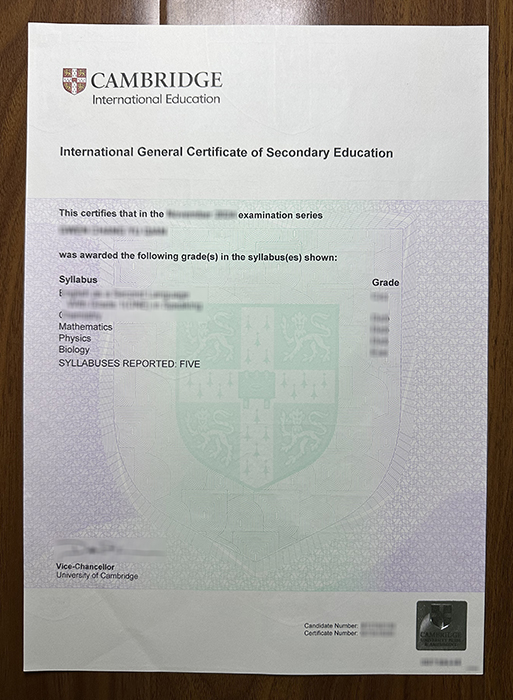
In the academic landscape leading to prestigious universities around the world, if A-Level or IB represent the final sprint stage that determines the ultimate height, then Cambridge IGCSE is the key cornerstone that determines the starting speed and endurance. The full name “International General Certificate of Secondary Education” (International General Certificate of Secondary Education), launched by the Cambridge International Examinations (CAIE), is a curriculum system that is not only the most widely used international curriculum among students aged 14 to 16 worldwide, but also serves as a “golden bridge” connecting junior high school and high school, as well as bridging native language education and the academic environment of the entire English language. Why so many people want to obtain a Cambridge IGCSE certificate?
I. Cambridge IGCSE: The Global Universal Academic “Buffer Zone”
Cambridge IGCSE is often regarded as the international version of the British GCSE curriculum, specifically designed for students whose native language is not English. In terms of the academic system, it corresponds to the junior high school to senior high school stage in China. However, in terms of teaching philosophy, there is a fundamental difference.
1. Flexible and Diverse Subject Marketplace
Unlike the “fixed package” teaching method in domestic education, IGCSE offers over 70 subjects for students to choose from. Students usually need to complete 5 to 14 courses within two years. Core subjects typically include English, mathematics, and science (physics, chemistry, biology), while elective subjects cover a wide range from art, design, business studies to computer science, foreign languages, and other fields. This “buffet-style” course selection model allows students to combine according to their interests and specialties, avoiding the pain of subject bias and enabling them to discover their academic potential at an early stage.
2. Experiential Learning Practice Ground
The greatest value of IGCSE lies in its “buffering” function. For students accustomed to the rote learning method, directly jumping into the high-intensity A-Level or IB courses often leads to “culture shock”. IGCSE helps students adapt to the English teaching environment, cultivating critical thinking and inquiry-based learning abilities. It is a critical transitional period from passive acceptance of knowledge to active construction of a knowledge system. How long does to get a Cambridge IGCSE certificate online?
II. IGCSE Certificate: A Highly Valued Academic Passport
When students complete two years of study and take the global unified examination, they will obtain the Cambridge IGCSE certificate. This certificate is not merely a proof of graduation from junior high school; it plays multiple core roles in college admission and academic planning.
1. “Navigation Instrument” for A-Level Course Selection
This is the most practical function of the IGCSE certificate. Most top international schools or high schools will strictly refer to IGCSE grades when admitting A-Level students.
Threshold Function: Many schools stipulate that to select physics in the A-Level stage, IGCSE physics or comprehensive science grades must reach B or A or above.
Prediction Basis: IGCSE grades can truly reflect a student’s subject strengths. If a student struggles very much in a certain subject during IGCSE and attempts to continue studying it in the A-Level stage, it may lead to unsatisfactory results when applying to universities later. Therefore, this certificate is an important “check-up” for students before entering advanced learning.
2. A Globally Recognized Independent Degree
Although usually serving as a transitional course, the IGCSE certificate itself has independent academic value.
Grade Classification: Grades range from the highest A* (or 9 points in the A*G system) to G. For applications to private high schools in the United States, Canada, or countries within the British Commonwealth, excellent IGCSE grades (such as five or more A*-A) are highly competitive application materials.
Solid evidence of English proficiency: For international students, if they achieve a grade of C or above in IGCSE English (a second language), it can often serve as proof of their English ability and be used to exempt IELTS or TOEFL scores when applying to universities. This significantly reduces the pressure of subsequent language tests.
3. The “key” to university admission in the Commonwealth
In the UK and some Commonwealth countries, IGCSE results are an important reference for university admissions officers when assessing students’ academic continuity. A student who has a steady improvement in grades from IGCSE to A-Level is more likely to be favored by admissions officers than a student who suddenly excels in A-Level but lacks the foundation of IGCSE.